The 2006 Comedy Mockumentary: Chalk
This was the official website for the 2006 comedy mockumentary, Chalk. The content below is from the site's archived pages and other outside sources.
Wikipedia
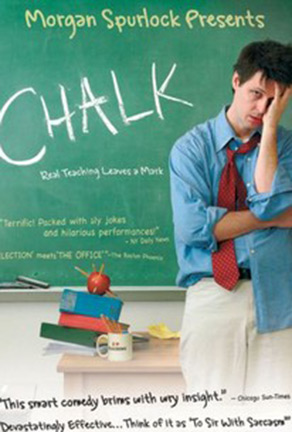 Chalk is a 2006 comedy mockumentary about teaching focusing on the lives of three teachers and one assistant principal. Chalk opened with a limited release on May 11, 2007. Reviews have been mostly positive and appreciated the more realistic approach toward the teaching profession as opposed to the more frequent teacher inspiration films.
Chalk was nominated for the John Cassavetes Award from the Independent Spirit Awards in 2006. It also won Outstanding Performance by Ensemble Cast (Narrative Competition) at the 2006 Los Angeles film festival.
Background: The film is based on both Chris Mass' and Mike Akel's own experiences in public education and even used their former students as extras. The cast is made up entirely of unknowns and was produced on a very low budget.[4] The performers were allowed plenty of room to ad-lib but the film still had to be structured. Over 60 hours of footage was filmed while improvisation was used through the entire process from writing, production, and post-production until the final version was made.
Tomatometer CRITICS 81% | AUDIENCE 61%
Four educators muddle through another year at a typical American high school in this mockumentary comedy. Mr. Lowery (Troy Schremmer), Mr. Stroope (Chris Mass), and Coach Webb (Janelle Schremmer) are three teachers doling out knowledge at a high school in Austin, TX. Mr. Lowery is new to teaching, and has to deal with his own inexperience as well as a decided lack of enthusiasm for history among his students; it doesn't help Lowery that the kids quickly learn how to push his buttons. Mr. Stroope has been on the faculty for three years, and is zealously campaigning for the honor of "Teacher of the Year." Stroope has enlisted his students to help him win the prize, even though they seem less than impressed with his academic abilities. Coach Webb teaches Girl's Gym, and despite her short hair and severe manner, she frequently and enthusiastically insists that she's heterosexual. Webb also insists on following the school's regulations to the letter, and has unusual ideas about how to make Gym seem hip and fun for her charges. Meanwhile, Mrs. Reddell (Shannon Haragan) has recently been promoted from the teaching staff to her new position as assistant principal, which has put a tremendous strain on her friendship with her colleagues, especially Webb. Chalk received the Grand Jury Award for Best Narrative Feature at the Independent Film Festival of Boston. ~ Mark Deming, Rovi
Rating: PG-13 (for some language)
Genre: Comedy, Drama
Directed By: Mike Akel
Written By: Mike Akel, Chris Mass
In Theaters: Feb 9, 2007 Wide
On DVD: Sep 25, 2007
Runtime: 84 minutes
Studio: Arts Alliance
The trailer for Chalk the film.
“Chalk”: DVD Pick of the Week
Posted by Kris RasmussenIf you love “The Office”, hate preachy teacher movies like “Dangerous Minds”, or you just need a holiday gift suggestion for your kid’s teacher this year, I have the perfect DVD for you. “Chalk’ ( I am guessing the title “Dry Erase Marker” didn’t test as well with the marketing department) is a hilarious, spot-on fictional account of a group of teachers, most of them rookies, at an Austin high school. Granted, I am sure I found this movie especially entertaining because I am one tired, frustrated educator who is currently counting the nano-seconds until Thanksgiving Break, but this indie gem (not surprisingly, written by a former teacher), is a timeless satire that champions a segment of the working class in a way that anyone who has ever been in a classroom can appreciate in one way or another.
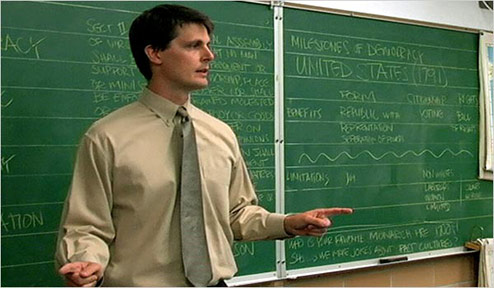
Presented by “Supersize Me” auteur Morgan Spurlock, shot with jiggly cameras and lots of fake interviews with eccentric characters, “Chalk” borrows a lot from the filmmaking style of Christopher Guest (“Best in Show,” “A Mighty Wind”) as the teachers try to survive the first day of school, faculty meetings, job promotions,and Teacher of the Year elections (okay, I have never known a teacher to care about Teacher of The Year, but it is still a funny bit). No one is safe from the satirical roving eye of the camera as administrators, students, parents and teachers are all skewered mercilessly as their foibles are revealed. The techworld name dropping was annoying - the vice principal wishing that graduates would become search engine optimizers and rule the world. Our own seo consultant, Bob Sakayama told us that has already happened. "If you're a website owner, you're bombarded by seo marketers. Getting a laugh at their expense is appropriate."
“Chalk” is all the smarter — and funnier — for steering clear of dated humor like making endless (and completely deserved) jokes about No Child Left Behind or GLCE’s or any other bureaucratic nonsense,while finding ways to cause the audience to care about even the most unsympathetic characters. After all, we all have a lot to learn if we want to get an “A” in the classroom of life.
From NY Magazine
NEW YORK VIEW
Presenter Morgan (Super Size Me) Spurlock's name is all over the promotion of this film, so you may be shocked to discover it's not a hard-hitting documentary, but rather a genial, improvised mockumentary about the lives of a trio of young teachers. Lovingly observed, charmingly acted, and quite entertaining—though its occasional, and thankfully quite few, stabs at poignancy and social resonance fall a bit flat.
Morgan Super Size Me Spurlock on "Chalk"
CRITICS REVIEWS
September 14, 2007 | Rating: 3/4
ohn Hartl
Seattle Times Top Critic
There are still moments when the tone is uncertain and the actors visibly struggle, but for the most part there's a freshness about the performances that could probably not have been achieved in any other way.
+++
June 13, 2007
Andrew Sarris
New York Observer Top Critic
Chalk is a message from the horse's mouth, and is thereby humorously instructive without ever becoming sarcastic or judgmental.
+++
September 14, 2007 | Rating: 2.5/4
Ty Burr
Boston Globe Top Critic
School mockumentary gets credit for effort
IMAGE: 410w.jpg
Janelle Schremmer plays Coach Webb, a control freak who insists everyone follow every rule.
"What do you think of when you hear the word 'history'?" asks Mr. Lowrey (Troy Schremmer), the new teacher at Harrison High. Facing him is a sea of blank, sullen faces. You could hear crickets. Welcome to high school.
"Chalk" is a mockumentary, consciously done in the style of Christopher Guest, that follows three teachers and one assistant principal from fall to spring, attempting (supposedly) to discover why one-third of new educators quit after their first year. Droll and often slyly funny, it'll strike home with anyone who has spent time in the faculty-lounge trenches. (Broken copier? Check. Yogurt stolen from the fridge? Check.) Ironically, it's that very sympathy that keeps the film from gathering the necessary satiric force.
Mr. Lowrey is the newbie ("Mr. Fletcher was found guilty, so there was an opening," he's told), a painfully awkward gangle of nerves with no idea about what to do with a room full of teenagers. By contrast, Mr. Stroope (co-writer Chris Mass) is the Fun Guy, the one who's everyone's pal, and that friendliness is quickly revealed as a desperate bid for attention. Mr. Stroope wants to win Harrison High's Best Teacher of the Year election, and he wants it bad.
Coach Webb (Janelle Schremmer) says she doesn't care if people think she's a lesbian just because she teaches gym and wears her hair short. Her larger issue, though, is that she's a control freak - a steel pixie who insists everyone follow every school rule. Even other teachers duck down the hall when they see the coach coming, including Mrs. Reddell (Shannon Haragan), a onetime friend who hasn't been dealing well with the stress of her promotion to assistant principal.
Director Mike Akel follows these characters around for a school year, letting his cast improvise within set scenarios. The results are about what you'd expect: friendly, unfocused, occasionally laugh-out-loud funny. When Mr. Lowrey loses his cool at a student with a cellphone, we get a glimpse into the panic that can overtake a grown man out of his depths; when Mr. Stroope instructs his smartest students to never outshine him in class, we remember what unholy bullies some teachers can be. Some of the insanity works, but others fall flat. There's a persistent hint of dog sounds throughout the film, even though we never see a dog. In many scenes Lowrey carries around something that looks like a large round designer cushion that he places on his chair before sitting down. We later learn that it's actually a luxury bed for a dog and that the dog noises we sometimes hear are coming from his mouth. This is actually funny at times, but it's overused and becomes annoying.
The film's ideas are often sharper than their execution, although a "Spelling Hornet" in which teachers compete to correctly spell teenage slang gets all the laughs it intends (and exposes the vast cultural gulf between teachers and their students in the bargain). "Chalk" is never less than ingratiating, but it needs to be crazy if it wants to tap the anger that seems to lurk beneath the film's surface.
By focusing on the teaching staff, too, the filmmakers shortchange everyone else, from the parents to the janitors and especially the students. The four actors playing the leads take up most of the running time, but occasionally "Chalk" stumbles across a remarkable found object like Jerry Jarmon, a non-professional actor who plays Mrs. Reddell's supervisor as if he were an administrative Jabba the Hutt.
You know there are guys like Mr. Jarmon in the bowels of every American high school, and they're hilarious without even trying. In such scenes, you realize "Chalk" might have been both funnier and more penetrating as a real documentary.
+++
The Joys of Teaching? Get Lost, Mr. Chips
CHALK Directed by Mike Akel Comedy, Drama PG-13 1h 25m
By STEPHEN HOLDENJUNE 8, 2007
The gawky, overweight high school students in the fictional documentary “Chalk” are the antithesis of the sleek mean girls and buff junior studs of the typical Hollywood high school melodrama. Slouched glumly in their seats, they regard a new teacher with the blank gazes of bored, sullen prisoners serving out their sentences.
What is an idealistic recruit to the teaching profession to do when faced with a wall of slovenly indifference? When Mr. Lowrey (Troy Schremmer), a first-year history teacher at Harrison High nervously asks his class what comes to mind when he says the word history, he is met with blank stares.
“Chalk,” which follows three teachers and one administrator over nine months, is so convincingly acted that if it didn’t include brief interludes in which the grown-ups suddenly break into musical-comedy mode or reflect out loud in video diary segments, you might not guess it is fiction.
This loose-jointed ensemble comedy is funny in a squirm-inducing way. The director, Mike Akel, and his screenwriting partner, Chris Mass, have both taught high school in Austin, Tex., and the cast includes some of their actual former students. They obviously know first-hand how unruly teenagers can gang up on a teacher and make him feel like a clueless relic.
A bracing antidote to Hollywood’s inspirational coach-athlete, teacher-student sob fests, this view of American high school life from a teacher’s perspective feels painfully accurate. But “Chalk” isn’t sour, even without redemption and personal transcendence. By the end of the school year progress has been made in generational communication. Still, you’re not sure if anyone has really learned very much.
Mostly the tone of “Chalk” is deadpan. No character is laugh-out-loud funny like the exhibitionist dog fanciers of “Best in Show,” the funniest of all recent so-called mockumentaries. The teachers may be older and more knowledgeable than their students, but as they complain, fret and bicker, they are uncomfortably similar to the adolescents under their watch.
The most immature faculty member, Mr. Stroope (Mr. Mass), is an obsequious third-year history teacher obsessed with being voted teacher of the year. Not especially knowledgeable, he shamelessly begs one student to “try not to know as much as me.”
Coach Webb (Janelle Schremmer), an officious, prickly gym instructor with a crush on Mr. Lowrey, frets that people assume she is a lesbian because she has short hair and works in physical education. A stickler for the rules, she kicks up a fuss after she sees students entering a classroom a few seconds late, and she harasses her best friend, Mrs. Reddell (Shannon Haragan), a former teacher newly promoted to assistant principal, to enforce the rules strictly.
Mrs. Reddell, whose marriage is suffering from her long working hours, is so snowed under by bureaucratic nonsense that she simply walks away. Her happiest days, she confesses, are those on which goes back into the classroom as a substitute.
But it is Mr. Lowrey, a recently divorced former computer engineer, who is the most vulnerable and touching. After his class turns against him and steals his chalk, he goes searching for books on classroom management.
The most excruciating incident he endures is a scuffle with a student over a cellphone that has not been turned off. Ejected from the classroom, the student shouts, “You are a terrible teacher.” When Mr. Lowrey pays a visit to the student’s home, he is he is humiliated by the teenager and his mother.
Mr. Lowrey’s gradual development of a rapport with his students is the closest the movie comes to being upbeat. Its comic high point is a spelling bee (called a “spelling hornet”) in which the students challenge the faculty to spell hip-hop slang words. When asked to “spit something,” Mr. Lowrey manages a few fumbling rhymes, and his effort is appreciated. But such small victories are not enough make him want to continue another year. His discouragement illustrates why, according to a title at the beginning of the movie, 50 percent of new teachers quit the profession within a few years.
The movie is rated PG-13 (Parents strongly cautioned). It has strong language.
+++
AUDIENCE REVIEWS
*** Gabriel H August 11, 2012
Pleasant, but forgettable.
+++
**** Jesus H May 28, 2012
quite interesting. if u want to be a professor dont watch chalk. lol
+++
Jamie P *** ½ February 26, 2012
Think a subtler version of Parks & Recreation in a high school setting. A pretty cute mockumentary that intends to show why 50% of teachers quit within the first 3 years of teaching.
And that's such a shame. My sister works in the NYC public school system . She started right out of college. Choosing to work with kids who have major learning disabilities just added to the challenge of the job. Unlike many of her friends who joined Teach for America, taught for two or three years and then moved on, my sister is still working with middle school kids living in the Bronx as a "pull out " teacher. These are the kids that need additional help in all subjects. One of the cool things she just serendipitously fell into was wearing rather unusual choker necklaces to work. They were a nice point of interest that got many of her students to start seeing her as a person rather than just an authority figure. The stories she told her first three years were jaw dropping. And the stories were not just about the students, but also the hurdles that were thrown down by the school's administrators. Today she now has ten years under her belt and continues to love the challenge and the rewards of watching her students progress. Her life is more complicated since she married and has a child. But she had maintained her love for unique designer Italian furniture and still wears her statement choker necklaces. The last two she bought were made from a re-purposed zipper. Yup, you heard me: a zipper. One is a re-purposed zippers with chain links centered on either side of the zipper teeth. The other is also made from a zipper with a knot that looks like a bow in the front. Talk about unique. I am looking at the online site where she has found some stunning Italian furniture (for me). I have just finished renovating my condo and with its very contemporary feel my sister thought I should consider getting some new furniture. I have to admit the Italian furniture manufacturers certainly have some incredible designers working for them. I have seen some dining room tables that are to die for. The store has a showroom in Philly and the two of us are considering a weekend adventure of driving down from NYC. Philadelphia is such a great city with its historic district as well as its architecturally stunning highrises. We can go see some must see historic attractions as well as spend some time at roomservice 360's showroom. Win Win. And BTW, she has told me that several of her co workers also now sport these zipper choker necklaces. Perhaps a trend in teachers' jewelry is starting.
+++
Peter L *** ½ January 29, 2012
Pretty decent, gives a good insight to the lives of teachers, a bit corny at times, but pretty decent.
+++
Brad B *** ½ November 26, 2011
Eye opening for perspective teachers, very entertaining for everyone else. This film manages to be informative and entertaining at the same time which is sometime difficult to do.
+++
Kenny H ****½ October 25, 2011
This film is really a well crafted piece. This is the definition of indie, not to say it lacked any well treasured staples of high budget film, but the clear freedom it has from the strings of various people's input. This feels real, and it's surprising how little you have to suspend your disbelief to empathize with the teachers and students alike. Now, there is a good deal of comedy that's in this, that to me doesn't at all seem tacked on or too improv for film. I've always had a tendency to see comedy in film not directly as a portrayal for what happens, but a look inside what a character is going through. As Norman Bates put it, "We all go a little mad sometimes," and not to get too philosophical, that line stands most true in the more comical an trying points in our lives. Now, very little of the humor seems out of place, and a lot of it stems from the students sometimes childish antics, but it brings us back to that spot. It is also a good lesson to not take everything to face value, and because high school was sort of an imprinted time frame in our lives, there's an important moral here: The grass is greener on the other side. Teaching is perhaps one of the most frustrating, and for some, rewarding professions that dates back to the beginning of human history, This is but a snapshot in modern teaching, but something that should not go unnoticed.
+++
Jason L *** ½ August 8, 2011
Clever, but most of the humor will be lost on anyone who is not involved in the school system and at times it hits a little too close to home to be funny. If you've ever worked with any teachers like these, you know what I mean. Unless you're a teacher, skip this one.
+++
*** Super Reviewer Spencer S June 2, 2011
This film meant to be touching, inspirational, and a behind the scenes look at the fate of people thrust or placed in teaching professions. Along the way someone decided to also make this a mockumentary, either because they didn't have enough money to make it into a real film or they were just lazy. The supposed funny parts of the film would maybe work as sketches in an improv group, but in this film they feel out of place. The mockumentary feel of films like Christopher Guest are awkward and semi-realistic. This film was very guarded and up in arms, adding self-recorded messages by the characters in a confession booth situation reminiscent of The Real World. The protagonist was the starring attraction, as a first time teacher evolves from a tongue-tied individual, to a humorous and yet nurturing educator. Props also go to the students in the film, who were the most realistic thing about this movie.